
Forestry Mulching vs. Traditional Land Clearing
Which Method Is Right for Your Property?
When you need to clear brush, overgrowth, or wooded areas from your property, there are several methods to choose from. Each has trade-offs in cost, speed, environmental impact, and end result. If you are a homeowner in New Hampshire, Massachusetts, or Southern Maine trying to decide between forestry mulching, brush hogging, or traditional cut-and-haul clearing, this guide breaks down the differences so you can make the right call for your property.
Traditional Land Clearing (Cut and Haul)
This is the old-school approach. A crew with chainsaws, a bulldozer, or an excavator cuts down trees and brush, pushes everything into piles, and then either burns the debris (if allowed) or loads it onto trucks and hauls it to a disposal site.
Pros
- • Handles any size tree
- • Can remove stumps and roots completely
- • Leaves bare ground ready for construction
- • Good for heavy timber removal
Cons
- • Most expensive method (hauling + disposal fees)
- • Tears up the ground with heavy equipment
- • Creates erosion problems on slopes
- • Slow — multiple pieces of equipment needed
- • May need burn permits (many NH towns restrict burning)
Brush Hogging (Rotary Cutter)
A brush hog is a heavy rotary mower pulled behind a tractor. It is the cheapest and fastest way to mow down overgrown fields, tall grass, and light brush on flat ground. Most brush hogs can handle vegetation up to 2 to 3 inches in diameter.
Pros
- • Cheapest option for large flat areas
- • Fast — covers a lot of ground quickly
- • Good for regular field maintenance
- • Widely available
Cons
- • Cannot handle thick brush or saplings over 3 inches
- • Rough, uneven cut
- • Throws rocks and debris (dangerous near buildings)
- • Cannot work on slopes, ditches, or uneven terrain
- • Tractor needs wide, flat access
Flail Mowing (Excavator-Mounted)
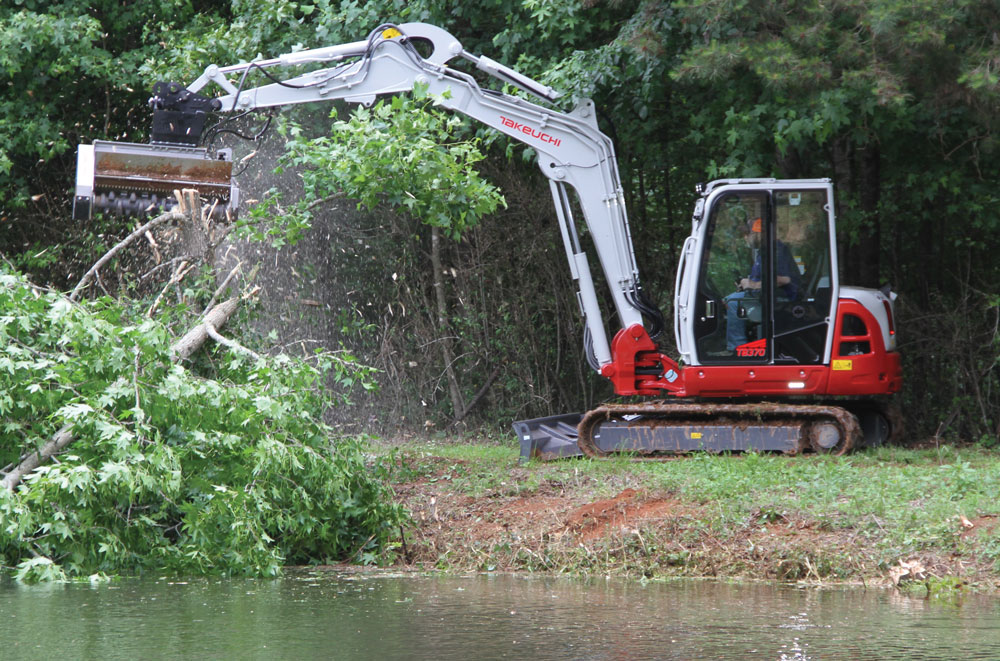
A flail mower is a drum-style attachment with free-swinging hammer blades that mounts on an excavator arm. It cuts, shreds, and mulches brush and saplings up to 4 inches in diameter. The excavator arm provides precision reach into slopes, ditches, tight spots, and areas inaccessible to tractors. This is the method we use at Stiles & Sons for most residential and commercial brush clearing jobs.
Pros
- • Clean, even cut with fine mulch left on-site
- • No hauling or disposal costs
- • Safe near buildings (enclosed drum, low debris throw)
- • Works on slopes, ditches, and tight spaces
- • Same machine can grade and prep the site after clearing
Cons
- • Limited to 4 inches — larger trees need chainsaw or mulcher
- • Slower than brush hog on wide-open flat fields
- • Not available from every contractor (specialized attachment)
Forestry Mulching (Dedicated Mulching Head)
A dedicated forestry mulcher is the heaviest-duty option. These machines use a large carbide-tipped drum to grind trees up to 6 to 8 inches in diameter into fine mulch. They are typically mounted on skid steers or large excavators and produce the finest end result.
Pros
- • Handles the largest vegetation
- • Produces the finest mulch
- • Excellent for reclaiming heavily wooded lots
- • One-pass clearing (no secondary cleanup)
Cons
- • Most expensive per-hour rate
- • Heavy machine can tear up soft ground
- • Overkill for light brush and residential lots
- • Limited availability in some areas
Which Method Should You Choose?
- Overgrown field with mostly grass and light weeds? Brush hogging is your cheapest option.
- Residential lot with dense brush, saplings, and vines? Flail mowing hits the sweet spot — cleaner than a brush hog, cheaper than a forestry mulcher, and the excavator reaches everywhere.
- Heavily wooded lot with trees over 4 inches? You need a forestry mulcher or traditional chainsaw clearing.
- Building site that needs bare dirt? Traditional clearing followed by grading, or flail mowing followed by excavation with our same machine.
- Slopes, ditches, or tight backyard access? Flail mowing on an excavator is the only practical option for terrain that tractors cannot reach.
Best Time of Year for Brush Clearing in NH
In New Hampshire, the best time for brush clearing is late fall through early spring (October through April) when the ground is frozen or dry and vegetation is dormant. Frozen ground supports heavy equipment without rutting, and bare branches make it easier to see what you are cutting. Spring and summer clearing works too, but wet ground and thick foliage can slow the job down. We clear brush year-round as long as the ground conditions allow safe access.
Not Sure Which Method You Need?
Send us a photo of the area and we will tell you which approach makes sense and what it will cost. No obligation. Call (978) 423-1204 or book a free estimate online.
Ready to Get Started?
Free estimates on all forestry mulching guide projects. Schedule your free quote today.
$150 off $1,500+ projects • $250 off $2,500+ • $500 off $5,000+